
Article summary: To become a licensed nail technician in Delaware, you need to complete 300 clock hours at a state-approved manicuring school, pass the Delaware state board exam, and apply for your manicuring license through the Delaware Division of Professional Regulation. At TSPA Delaware, full-time students complete those 300 hours in roughly two to three months. This article walks through every step of the process, what the program actually covers, and what to expect from your first day of class to the day your license arrives.
The manicuring program is one of the most underrated paths in the beauty industry. It is shorter than cosmetology, more focused than esthetics, and the demand for skilled nail technicians in Delaware is consistent year-round. The barrier to entry is real but manageable. Three hundred hours, a board exam, and a license application stand between where you are now and a career behind the nail table.
Here is exactly how that process works at TSPA Delaware.
Delaware does not require a college degree or prior beauty industry experience to enroll in a manicuring program. The state does require that students be at least 17 years old at the time of enrollment. A high school diploma or GED is required for enrollment at TSPA Delaware, which is consistent with most accredited cosmetology and manicuring schools across the state.
Beyond those basics, no specific background is required. People come to manicuring programs from all kinds of prior careers and situations. Some are recent high school graduates. Others are career changers in their 30s, 40s, or later who want a shorter training commitment and a skill set they can build a business around. The program is designed to take you from no professional nail experience to licensed and job-ready.
Delaware state law requires 300 clock hours of manicuring training at a state-approved school before you can sit for the board exam. That is the legal minimum, and every licensed manicuring school in Delaware builds its program around that requirement.
At TSPA Delaware, full-time students attend five days a week and typically complete their 300 hours in approximately two to three months. Part-time students with fewer available days per week will take longer, but the same 300-hour total applies regardless of pace. Attendance consistency is the single biggest factor in how quickly a student finishes. Every missed day extends completion by an equal number of hours, so students who treat attendance like a job tend to finish closest to the minimum timeline.
The full schedule breakdown and current enrollment dates are on the manicuring program page.
Three hundred hours sounds like a long time until you consider how much there is to learn in nail care. The Delaware manicuring curriculum is set by the state board and covers both the hands-on techniques and the theoretical knowledge students need to pass the written portion of the board exam.
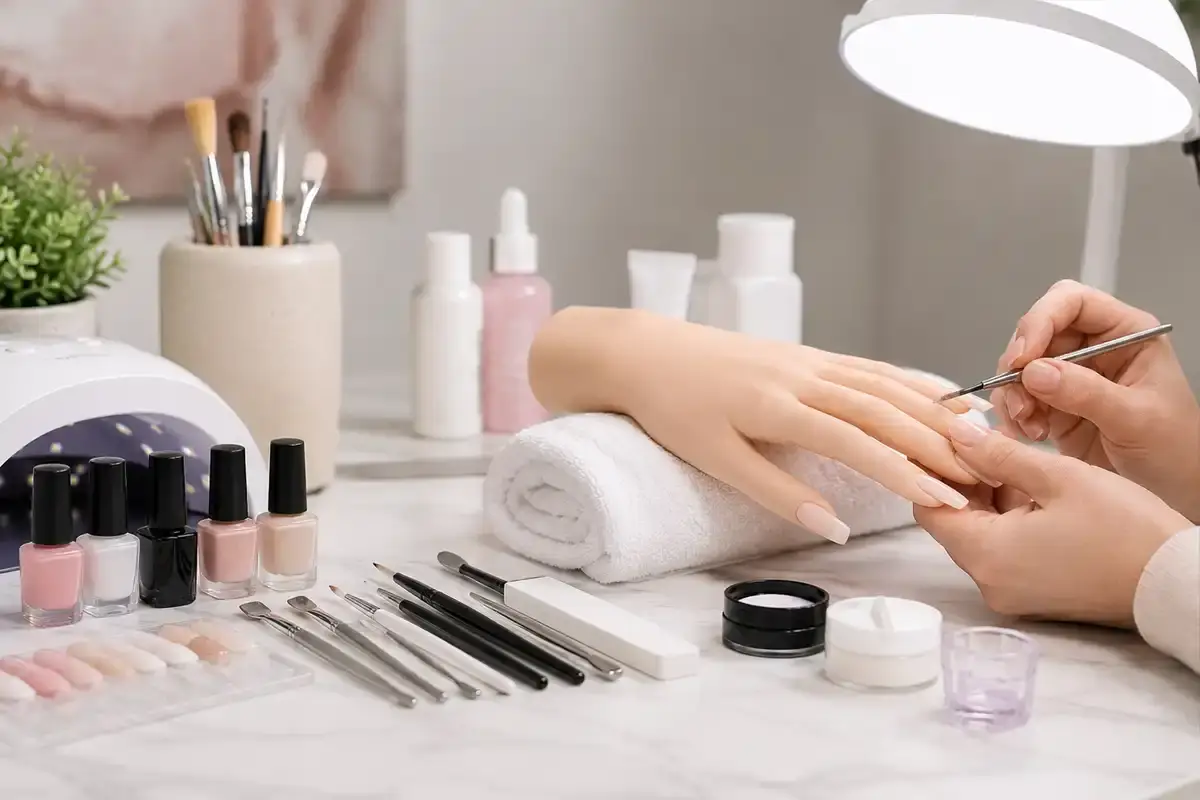
The practical side of training covers basic manicures and pedicures, nail shaping and filing techniques, cuticle care, nail polish application, and the application and removal of nail enhancements including acrylic and gel systems. Students practice each technique repeatedly on real clients in the student salon under instructor supervision. That client-facing experience is where skill actually develops, not just in classroom drills.
The theory portion of the curriculum covers nail anatomy and physiology, skin structure and the nail unit, common nail conditions and diseases, chemical safety for the products used in nail services, and Delaware state law regarding the professional standards nail technicians are held to. The written board exam draws heavily from this portion of the curriculum, so students who stay current on theory alongside their hands-on hours tend to pass the exam with less cramming at the end.
Sanitation and infection control take up a meaningful portion of the curriculum as well. This is not filler content. Nail services involve direct contact with skin and the nail bed, and improper sanitation protocols create real health risks for clients. The state board tests on this extensively, and employers care about it even more. A nail tech with strong sanitation habits protects clients and protects her own license.
TSPA Delaware students receive a professional-grade student kit at the start of the manicuring program. The kit includes the tools and supplies used throughout training, from nail files and buffers to the implements used for acrylics and gel services. Having consistent access to professional tools from day one rather than piecing together a kit independently is one of the practical advantages of enrolling in an accredited program.
The full breakdown of what comes in the kit and how each item is used in training is covered in detail on the nail tech student kit page.
After completing the 300 required hours, the next step is the Delaware state board exam. The exam has two components: a written portion and a practical portion. The written exam tests knowledge of nail theory, anatomy, sanitation, chemical safety, and Delaware state law. The practical exam tests hands-on technique on a live model or mannequin hand, depending on the specific exam format in effect at the time of testing.
Most TSPA Delaware students schedule their board exam in the final weeks of their program rather than waiting until graduation day. The registration and scheduling process takes some lead time, and building that into the end of the program rather than treating it as an afterthought means graduates move directly into the licensing process without a gap between finishing school and sitting for the exam.
Exam prep is built into the TSPA Delaware curriculum. Students complete practice theory tests throughout the program, not just as a final-week scramble. That steady preparation is what leads to strong board pass rates.
Passing the board exam is the final academic hurdle. After results are confirmed, the last step is submitting a license application to the Delaware Division of Professional Regulation through the Board of Cosmetology and Barbering. The application includes your exam results, proof of program completion, and the required application fee.
Processing time for a new license typically runs two to four weeks after a complete application is received. Students who submit promptly after receiving their exam results generally have their license in hand within a month of finishing school. The full licensing process for Delaware credentials is outlined on the Delaware license requirements page, which covers the board application steps in detail.
A Delaware manicuring license authorizes you to perform nail services on clients in a licensed nail salon, spa, or full-service salon that offers nail services. That includes manicures, pedicures, nail enhancements, gel and acrylic services, nail art, and related services within the defined scope of the manicuring license.
Many nail technicians work in existing salons as employees or booth renters when they first get licensed, building a client base before considering independent or suite-based work. Others work in spas or resort environments, particularly in Sussex County where seasonal tourism creates strong and consistent demand for nail services. Delaware’s coastal geography makes nail technician work especially steady in the Dagsboro and Rehoboth Beach areas, where spa and resort appointments peak from spring through fall.
The student salon at TSPA Delaware also gives prospective clients a look at the kind of work students produce. Services performed by enrolled students under licensed instructor supervision are available to the public at accessible pricing. Details on current services and availability are on the salon services page.
The manicuring program at TSPA Delaware is eligible for federal financial aid for students who qualify, including Pell Grant funding available through the FAFSA. Because the program is shorter than the full cosmetology program, the total tuition is lower, which means grants can cover a larger proportion of the cost for qualifying students.
A one-on-one conversation with TSPA Delaware’s financial aid team is the most reliable way to understand what a specific student qualifies for before enrollment. Trying to estimate aid eligibility independently through online calculators tends to produce rough numbers that do not account for individual circumstances. The financial aid page has the FAFSA school code and the contact information needed to start that conversation.
Delaware requires 300 clock hours of manicuring training at a state-approved school. After completing those hours, students must pass the Delaware state board exam before applying for a manicuring license.
At TSPA Delaware, full-time students complete the 300 required hours in approximately two to three months. Part-time schedules extend that timeline depending on how many days per week a student attends.
The Delaware manicuring board exam has a written component covering nail theory, anatomy, sanitation, chemical safety, and state law, and a practical component testing hands-on technique. Both portions must be passed to qualify for a manicuring license.
Yes. A Delaware manicuring license authorizes nail enhancement services including acrylic and gel systems within the defined scope of the manicuring license. These techniques are taught as part of the manicuring program curriculum at TSPA Delaware.
Yes. TSPA Delaware offers a state-approved manicuring program that prepares students for the Delaware manicuring board exam. The program includes hands-on client hours in the student salon and a professional-grade student kit. Federal financial aid is available for qualifying students.