
Article summary: Dermaplaning is a manual exfoliation treatment that uses a sterile surgical-grade blade to remove dead skin cells and fine facial hair from the surface of the skin. It leaves the skin smoother, brighter, and better prepared to absorb skincare products. The service has grown into one of the most requested treatments at salons and spas in Delaware, particularly in Sussex County where the clientele skews toward appearance-conscious resort and beach visitors. This article explains what dermaplaning is, how it works, who it is appropriate for, and what training esthetics professionals in Delaware pursue to perform it at a high level.
Dermaplaning has moved from specialty treatment to mainstream request in a short period of time. Clients who once had to seek it out at medical spas now expect to find it at skilled estheticians across Delaware. That shift has created both an opportunity and a professional responsibility. An esthetician who performs dermaplaning well builds loyalty fast. One who performs it without proper training puts clients at real risk.
Understanding the service from both the client’s perspective and the professional’s is the right starting point for anyone navigating dermaplaning in Delaware.
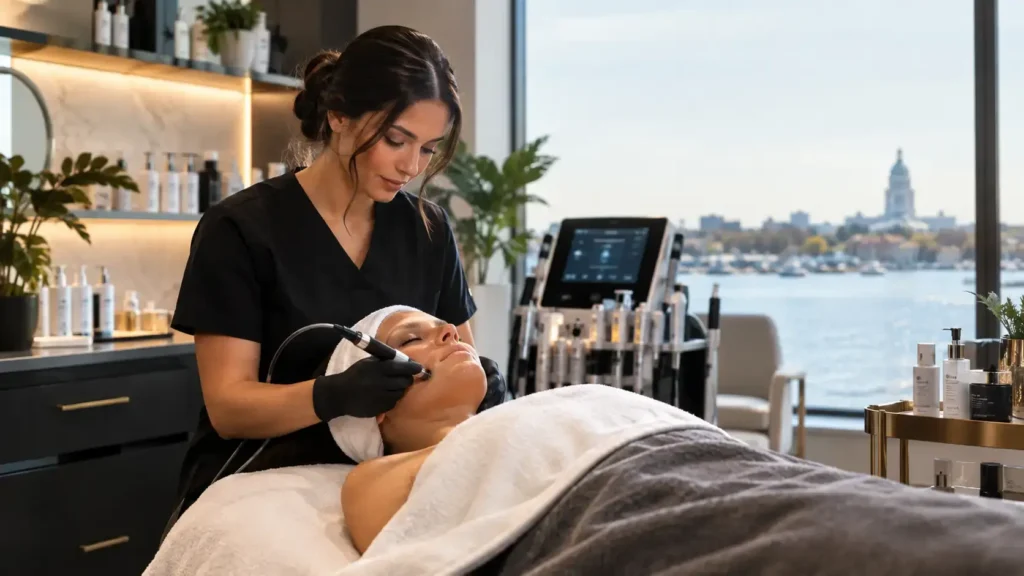
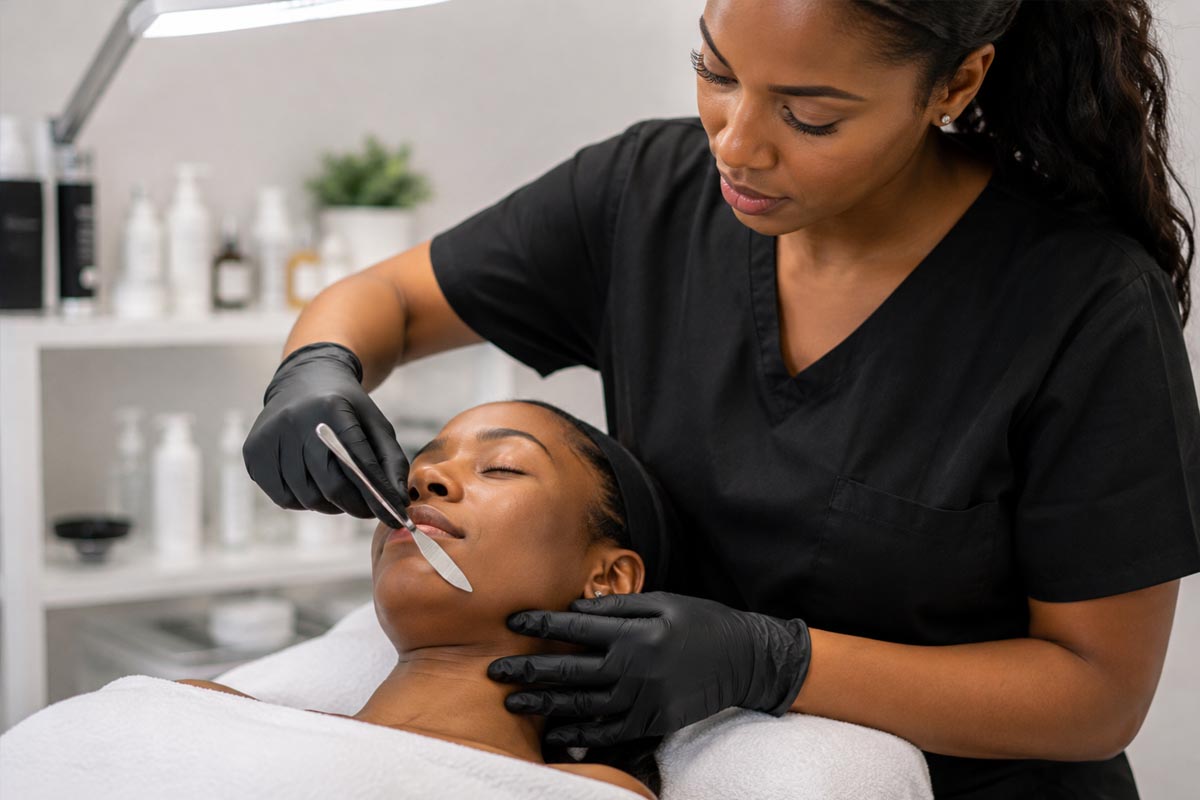
Dermaplaning uses a sterile, surgical-grade 10R blade held at a precise angle against the skin. The esthetician performs short, feathering strokes across the surface of the face. Those strokes lift and remove two things at once: the outermost layer of dead skin cells that accumulate on the surface, and the fine vellus hair, commonly called peach fuzz, that sits in the same layer.
The result is immediate and visible. Skin feels dramatically smoother to the touch. Texture irregularities are reduced. The complexion looks brighter because light reflects more evenly off a smooth surface than a rough one. Makeup sits differently afterward, too. Foundation applies more evenly and lasts longer when it is not sitting on top of a layer of dead skin and fine hair.
Beyond the surface effect, dermaplaning also prepares the skin to receive skincare products more effectively. With the surface barrier of dead cells removed, serums and moisturizers penetrate more efficiently. This is why dermaplaning is often performed as a preparatory step before other facial treatments rather than as a standalone service.
This is one of the most common questions from clients who have not experienced the service before. Dermaplaning does not hurt. Most clients describe the sensation as a light scraping feeling, similar to a dull razor moving across the skin, without any cutting sensation. There is no heat, no suction, and no discomfort when performed correctly.
The treatment is almost entirely relaxing. Sessions typically run 30 to 45 minutes for a full face treatment. Some clients fall asleep on the table. The complete absence of downtime afterward is a major part of its appeal. Clients can return to normal activity immediately, including wearing makeup the same day, which is unusual for an exfoliation treatment of this depth.
Dermaplaning works particularly well for clients with dry or dull skin, uneven texture, fine lines that appear more prominent under certain lighting, or visible peach fuzz that affects makeup application. It is also popular among clients who want the benefits of exfoliation without the chemical sensitivity that sometimes accompanies acid-based peels.
That said, dermaplaning is not appropriate for every client. Active acne breakouts are the most common contraindication. The blade cannot safely be used over active lesions, and attempting to do so increases the risk of spreading bacteria and causing scarring. Rosacea, eczema, psoriasis, and other inflammatory skin conditions may also be contraindications depending on the severity and current state of the condition. Highly sensitive skin that reacts to most treatments needs individual assessment before proceeding.
A skilled esthetician performs a thorough skin analysis and consultation before every dermaplaning service. That consultation is not optional. It is what separates a safe, effective treatment from a harmful one. The training to conduct that consultation properly is as important as the technique itself.
This is the most persistent myth about dermaplaning, and it is worth addressing directly. No. Dermaplaning does not change the texture, color, or growth rate of facial hair.
Hair thickness is determined by the follicle, which sits far below the surface of the skin. Dermaplaning only touches the very top layer of the skin. It has no contact with and no effect on the follicle. The reason some clients perceive regrowth as coarser is that the hair has been cut straight across at the surface, creating a blunt tip rather than the natural tapered tip of an uncut hair. That blunt tip can feel slightly different when it first emerges. The hair itself is exactly the same.
Correcting this misconception confidently and accurately is part of what separates an educated esthetic professional from someone who simply performs a treatment and moves on.
Sussex County and the broader Delaware coastal market draw a clientele that prioritizes skincare and appearance maintenance. Resort guests, beachgoers, and wedding clients all want their skin looking its best on a specific timeline. Dermaplaning fits that demand particularly well because results are immediate and there is no recovery period.
A bride who books dermaplaning four to seven days before her wedding sees noticeably smoother, more luminous skin on the day without any risk of post-treatment redness or peeling. A resort guest visiting for a long weekend wants a treatment that enhances their appearance without keeping them off the beach for two days. Dermaplaning delivers both.
That demand creates real earning potential for esthetics professionals in Delaware who offer the service well. Dermaplaning commands strong pricing relative to the time required, retains clients through visible results, and pairs naturally with add-on services like facial masks, LED light therapy, and serum infusion treatments.
Dermaplaning training is not part of the standard esthetics curriculum at most schools. It is an advanced technique that requires specific instruction in blade handling, angle and pressure control, contraindication assessment, and post-treatment protocols before a professional is ready to perform it on clients.
Most working estheticians add dermaplaning to their skill set through advanced education courses after completing their foundational training. Those courses cover the theory behind the treatment, proper blade selection and disposal, technique development on practice surfaces before progressing to live models, and how to build a dermaplaning menu into an existing service offering.
TSPA Delaware’s Advanced Education Program offers specialty training opportunities for credentialed beauty professionals looking to expand their service menus with in-demand treatments. The esthetics program at TSPA Delaware provides the foundational skin science and hands-on treatment experience that prepares students for exactly this kind of advanced training down the road. For anyone still deciding whether esthetics is the right direction, the broader case for why now is a strong time to enter the field is covered on the growing demand for estheticians page.
Most clients see their best results within 24 to 48 hours of treatment. Immediately after, the skin may look slightly pink, which typically fades within an hour or two. The smoothness is noticeable immediately. The brightness often continues to improve over the following day as the skin settles.
Post-treatment care matters. Clients should avoid direct sun exposure without SPF protection for at least a week after treatment, since the freshly exfoliated skin is more susceptible to UV damage. Heavy or occlusive products should be avoided for the first 24 hours. Gentle hydration and SPF are the most important post-care steps.
Most clients schedule dermaplaning every four to six weeks, which aligns with the natural skin cell renewal cycle. Regular treatments maintain the results and build on them over time, making it a strong service for building a recurring client base.
Clients in Delaware who want to experience dermaplaning through TSPA Delaware’s student salon can find current service availability on the salon services page.
Dermaplaning is a manual exfoliation treatment performed by a trained esthetician using a sterile surgical-grade blade to remove dead skin cells and fine facial hair from the surface of the skin. It leaves the skin smoother, brighter, and more receptive to skincare products.
No. Most clients describe the sensation as light scraping with no pain or discomfort. When performed correctly by a trained professional, dermaplaning is a relaxing treatment with no recovery time afterward.
No. This is a common myth. Dermaplaning does not affect the hair follicle and does not change the texture, color, or growth rate of facial hair. The blunt tip of regrown hair may feel slightly different at first, but the hair itself is unchanged.
Dermaplaning is contraindicated for skin with active acne breakouts. However, clients with non-active acne-prone skin or post-acne scarring may benefit from the treatment. A qualified esthetician assesses each client individually before proceeding.
Most clients schedule dermaplaning every four to six weeks, which aligns with the skin’s natural cell renewal cycle. Regular treatments maintain results and support long-term skin health.
Dermaplaning is an advanced technique typically taught through specialty continuing education courses for credentialed esthetic professionals. TSPA Delaware’s Advanced Education Program offers advanced training opportunities for working beauty professionals in Delaware looking to expand their service menus.